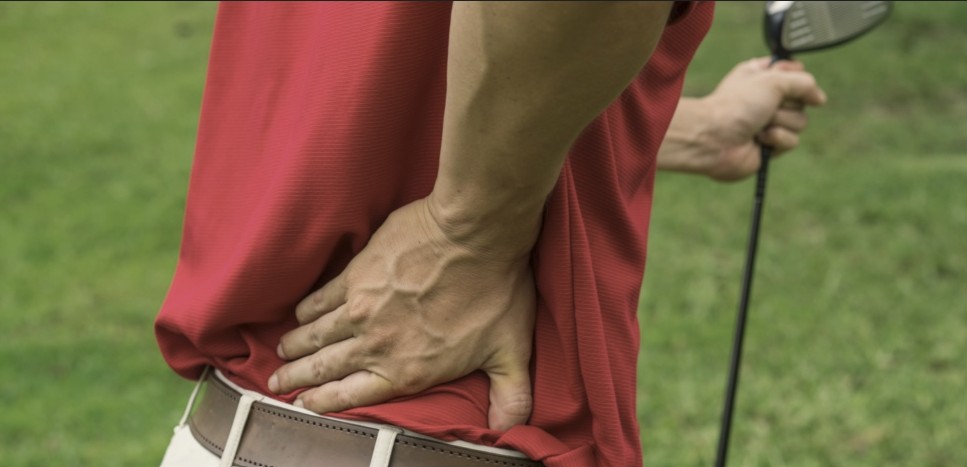
Golf is one of the few sports played almost entirely in one direction. Hours every week rotating your spine, loading your hips, firing your shoulders the same way. If you're right-handed, your left side brakes and your right side accelerates. Thousands of reps, one direction.
Over time, this creates real imbalance. One hip tightens. One side of your lower back overworks to compensate. Your core develops unevenly. None of this is visible until something breaks.
How Imbalance Becomes Injury
When your body is imbalanced, it finds workarounds. If your lead hip can't rotate properly because it's overworked, your body steals that rotation from your lower back. This is why lower back pain is the most common injury in golf. It's rarely the back's fault. It's the back picking up the slack for hips that stopped doing their job.
Training only your dominant movement pattern only accelerates this pattern. Every rep in one direction without a counterbalance is adding to the imbalance.
Why Symmetry Makes You Faster
Your central nervous system won't let you swing faster than you can safely decelerate. If your non-dominant side is weak, your body governs your swing speed to protect you during the follow-through. It's a built-in speed limiter you didn't know you had.
Train both sides equally, especially the non-golf side, and you're strengthening the brakes. Stronger brakes means the central nervous system (CNS) releases the governor. You swing harder because your body trusts that it can stop.
In the gym, it's easy to default to bilateral movements like squats and deadlifts. Those matter. But golf demands unilateral and anti-rotational work too. Single-leg deadlifts, Pallof presses, split squats. GolfBod programs these automatically, balancing both sides so your training doesn't reinforce the asymmetry your sport creates.
Sources: